Choose 304 for indoor washdown with mild cleaners, general industrial plants and dry outdoor sites like the Southwest desert. Choose 316 where chlorides are present: coastal and marine sites, de-icing salt, wastewater and chemical treatment, swimming pools, and food plants that use chlorinated sanitizers or brines. 316 adds 2 to 3 percent molybdenum, which resists chloride pitting, and it typically costs more.
What NEMA 4X means
NEMA 250 defines a Type 4X enclosure as one built for indoor or outdoor use that protects the equipment inside against falling dirt, rain, sleet, snow, windblown dust, splashing water and hose-directed water, and that also resists corrosion. The "X" is the corrosion part: to qualify, the enclosure is put through salt-spray testing and compared against a Type 304 stainless steel test specimen.
That means 304 stainless is the benchmark for NEMA 4X corrosion resistance. 316 is not needed to earn the rating. It is the upgrade for environments harsher than the test.
How the two grades differ
| Type 304 | Type 316 / 316L | |
|---|---|---|
| Typical composition | About 18% chromium, 8% nickel | About 16% chromium, 10% nickel, 2–3% molybdenum |
| Chloride resistance | Good in low-chloride water and air | Much better: molybdenum resists pitting and crevice corrosion |
| Typical uses | Indoor washdown, general industry, dry outdoor sites | Coastal, marine, de-icing salt, wastewater, chemical and pool areas |
| Cost | Baseline | Generally higher; one major enclosure maker puts it about 25–35% above 304 |
| Welded construction | 304L for heavy welding | 316L (low carbon) is the usual choice for welded enclosures |
Rittal's stainless enclosure white paper gives a useful rule of thumb: 304 resists corrosion in water containing up to about 100 ppm chloride, and 316 up to about 1,000 ppm. Neither grade holds up to prolonged seawater exposure without maintenance.
When 304 is the right call
- Indoor food, beverage and packaging lines washed down with mild, non-chlorinated cleaners
- General industrial and process plants without chemical splash
- Dry outdoor sites, including most of the desert Southwest away from pools and salt
- Projects where the budget is better spent on a larger enclosure, better gaskets or a sloped top
When 316 pays for itself
- Coastal and marine installations within reach of salt air or spray
- Lift stations, treatment plants and chemical-feed rooms with chlorine or hypochlorite
- Food plants that sanitize with chlorinated chemicals or handle brines
- Roadside and parking structures exposed to de-icing salt
- Pool, spa and water-feature equipment rooms
Replacing a pitted enclosure in the field (new box, rewiring, downtime) costs far more than upgrading the grade up front. If chlorides are in the picture, specify 316.
Details that matter as much as the grade
- Finish: smoother finishes give corrosion and soil fewer places to start. #4 brushed is the common standard.
- Welds: continuous welds, ground smooth and passivated, avoid crevices where corrosion starts.
- Sloped tops: water and washdown chemicals run off instead of pooling.
- Hardware and fittings: match or exceed the enclosure grade so a cheap hinge or fitting doesn't fail first.
- Cleaning: both grades last longest when deposits are rinsed off regularly.
How Stainless Mania builds NEMA 4X enclosures
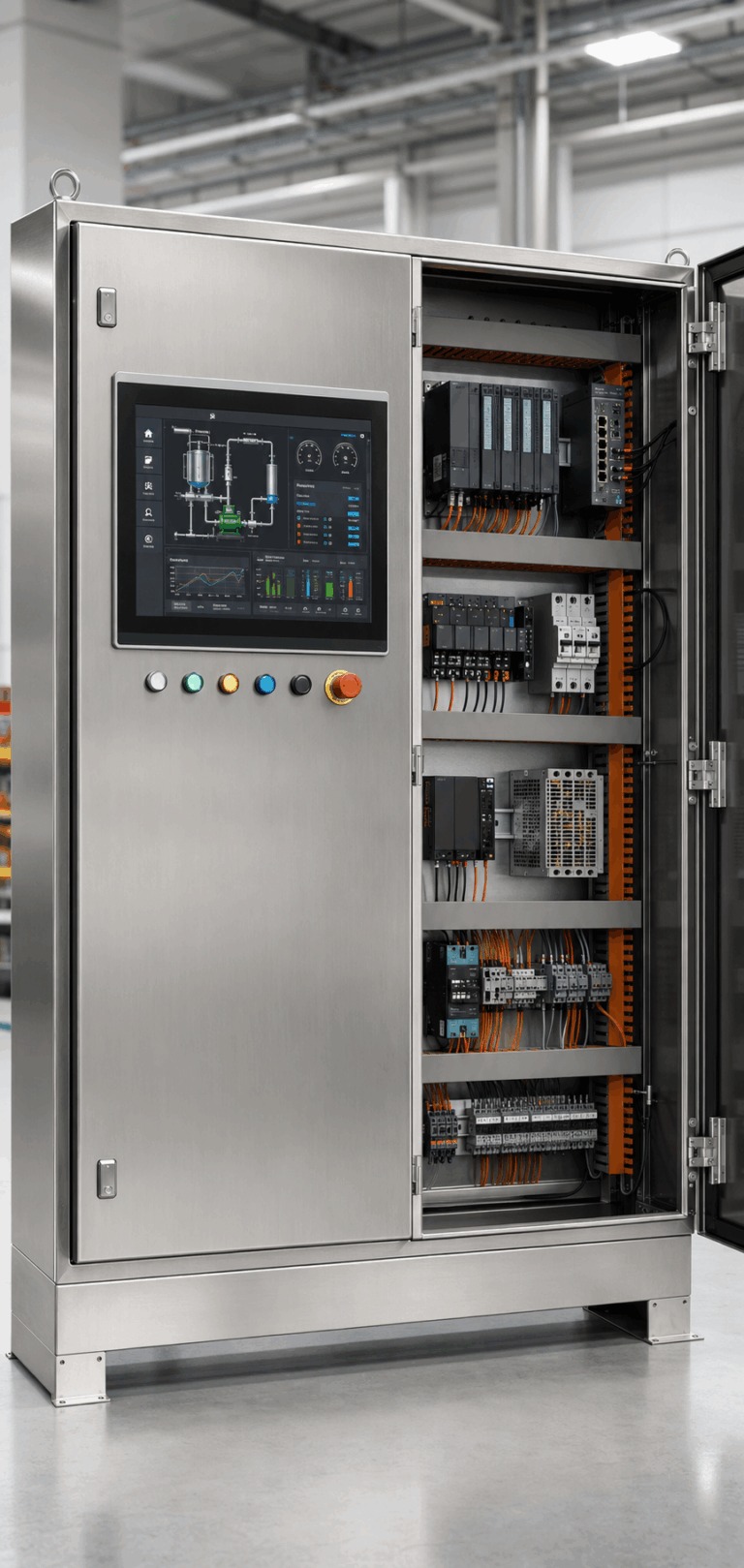
We cut, form, weld and finish NEMA 4X enclosures to your print in 304 and 316 stainless, as well as aluminum and painted carbon steel for other ratings. Water and wastewater panels go into 316 for chloride service, and sanitary washdown enclosures are built in 316 with sloped tops. Because we are also a UL 508A panel shop, the enclosure can ship wired, tested and ready to install.