Choose a second source on proof, not price. Look for a certified UL 508A shop that builds to your print without changes, controls revisions, asks before substituting any component, delivers a full documentation and test package, and agrees to a first-article approval before production. A builder that also fabricates the enclosure removes another vendor from the chain.
Why OEMs add a second source
- Capacity: demand spikes faster than one panel shop can hire and train.
- Risk: a single supplier is a single point of failure for every machine you ship.
- Lead time: a qualified alternate can take overflow while your primary builder works through its backlog.
- Leverage: two qualified builders keep quality, schedule and pricing honest.
The eight-point qualification checklist
| What to check | Why it matters | What a good answer looks like |
|---|---|---|
| 1. Certification | Your panels must carry the same listing as the units your primary builder ships | A UL 508A certified shop you can verify in UL Product iQ |
| 2. Build to print | Every unit has to match the released drawing, whoever builds it | Works from your schematic, layout and BOM, and raises questions in writing |
| 3. Revision control | Builds to an old revision cause field failures and recalls | Confirms the drawing revision on every order and tracks your engineering changes |
| 4. Substitution policy | An unapproved part can change the SCCR or the listing | No substitutions without your written approval; alternates proposed with datasheets |
| 5. Documentation | You need the same records from both suppliers | As-built drawings, SCCR calculation, BOM and test records with every unit |
| 6. Testing | Defects found at your dock cost more than defects found at theirs | Continuity, insulation resistance and powered functional test before shipment |
| 7. First article | Proves the builder can produce your design before you commit volume | A first-article unit for your inspection, or a factory test you can witness |
| 8. Single-shop scope | Every handoff between vendors adds delay and finger-pointing | Enclosure fabrication, machining, wiring and testing under one roof |
How to onboard a second source
- Send the full release package: schematic, panel layout, BOM with approved manufacturers, labeling, test procedure and the current revision level.
- Get a written quote review: the builder should come back with questions, long-lead items and any proposed alternates before quoting.
- Build and approve a first article: inspect it against your drawing, or witness its factory test, before releasing production.
- Release production with change control: agree how engineering change notices reach both builders on the same day.
- Share demand early: a rolling forecast lets the second source stock long-lead components before you need them.
Red flags
- The shop can't show its UL 508A certification, or the name doesn't match UL Product iQ.
- Quotes come back fast with no questions about a complex drawing package.
- A "we'll use an equivalent part" answer with no approval step.
- No test record, or a test that stops at continuity checks.
- The enclosure, machining and wiring are spread across three different subcontractors.
How Stainless Mania works as a second source
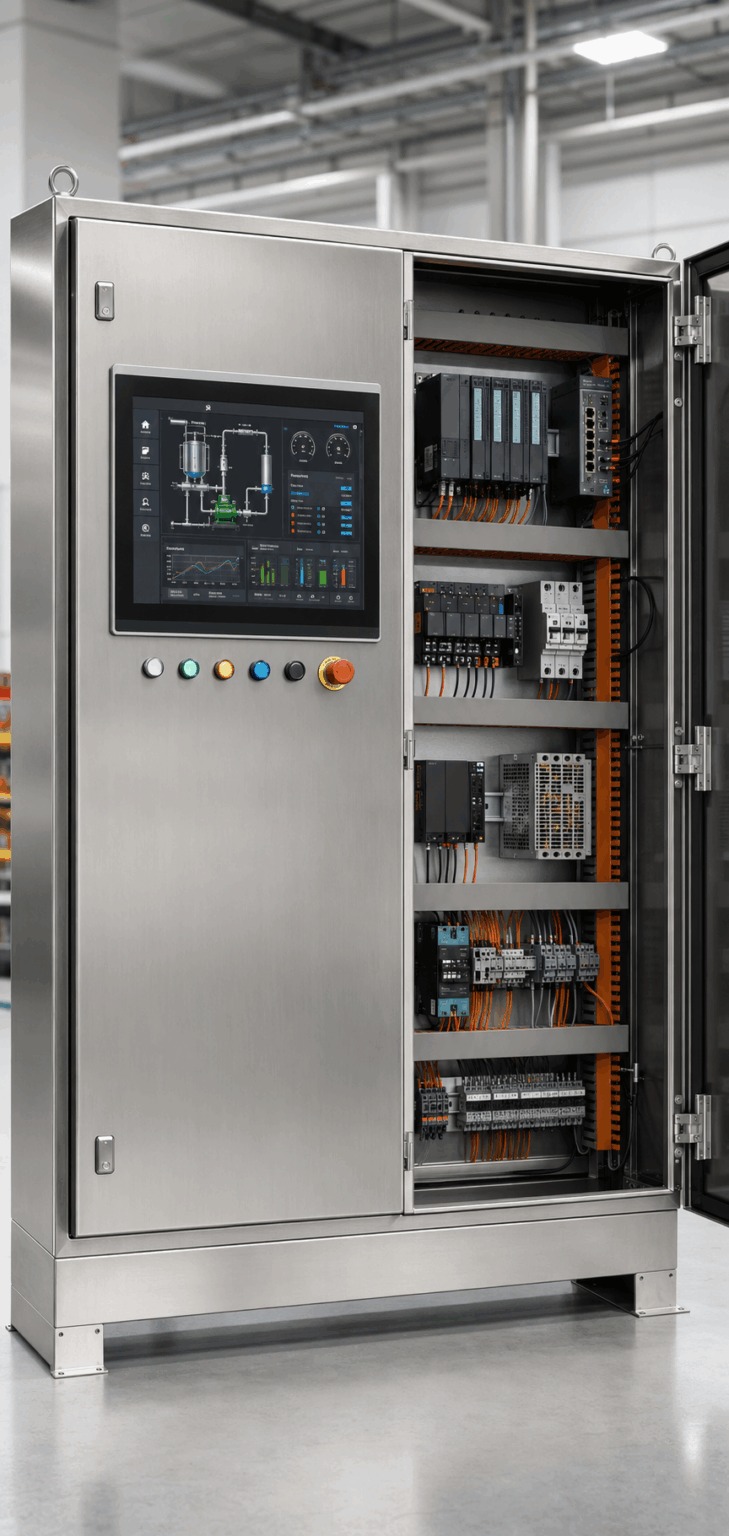
We regularly qualify as an alternate supplier for OEM products already in production. We build from your schematics, layout and bill of materials, and we don't substitute components without your approval. Every panel gets continuity, insulation-resistance and powered functional tests and ships with as-built drawings, the SCCR calculation, the BOM and test records. Our Las Vegas shop is UL 508A certified and fabricates stainless enclosures, machines cutouts and wires panels in one building, from a single first article through ongoing production runs.